
Finding Irvine Residents by Clue
Start with the strongest fact you already hold. A street address leads to the City of Irvine parcel map, the county assessment route, permits, and recorded documents. A name can point to a court index, a business filing, a professional license, or an old newspaper hit. Older households are harder. Irvine did not incorporate until the modern village system was already taking shape. A countywide directory, census schedule, obituary, or ranch-era collection may be needed instead.
No single record answers every question. An assessed owner is not every person in a household. A deed proves a transfer, not who slept there. A voter lookup only confirms the person using it. It is not an open street list. Keeping those limits in sight is the safest way to move from a broad clue toward a record that its custodian can check.
- Normalize the name or address, including middle initials, former names, spelling variants, street suffixes, and the likely time period.
- Use Irvine GIS or the county address route to identify a parcel or APN when the starting clue is a street.
- Use the APN and legal description with the Orange County Assessor and RecorderWorks, then separate index facts from document copies.
- Check the Orange County court, vital, business, license, newspaper, and directory channels that fit the person and era.
- Request an existing, identifiable record from the city or county when the online path ends, while respecting exemptions and confidential records.
A single person needs a name-focused cross-check. That gathers the evidence in one place, while a whole street takes a different sequence. The Irvine street directory by address works from the parcel upward rather than from the person.
Irvine Offices Behind Resident Records
Irvine is the local requester. But Orange County holds the core deed, assessment, election, vital, and Superior Court systems. Santa Ana, the county seat, houses the principal Clerk-Recorder and Superior Court facilities. City records still matter for ordinances, agreements, and permits. Plans and administrative documents tied to an address or project also live there.
Each office answers a different question. The Recorder indexes parties to instruments. The Assessor organizes parcels and values. The Registrar authenticates a person's own voter record and administers qualified data requests. The City Clerk's Office of Records and Information handles municipal records. It also provides the CPRA request route.
Orange County Clerk-Recorder
Principal county facilities: Santa Ana
Recorder index only online
Orange County Assessor
500 S. Main St., 2nd Floor
Orange, California
714-834-2727
Registrar of Voters
1300 S. Grand Ave., Building C
Santa Ana, CA 92705
714-567-7600
Irvine Records and Information
1 Civic Center Plaza
Irvine, CA 92606
949-724-6281
Irvine Quick Records and Permit Trails
OnBase is the city of Irvine's municipal search system. It covers agendas, minutes, resolutions, ordinances, contracts, and some permit records. The guidance allows asterisks at the start or end of text and recommends a date range. For building permits, enter the street number and street name without a suffix or abbreviation for a better match. These records show city activity around an address. They are not a verified resident list.
The same distinction matters in the Building and Safety portal. Existing plan-check and permit inquiries need no login. Issuing a permit requires registration. A permit result may show the owner listed at application time, the applicant or contractor, the project, status, dates, and inspection history. That is solid evidence of construction or alteration, but it does not prove the named person lived at the property.
| OnBase Search Element | Type | Use in an Irvine Search |
|---|---|---|
| Keyword field | Text | Try a focused word or wildcard such as *Irvine*. |
| Date range | Date pair | Narrow a broad public-record result set. |
| Basic Search | Mode | General indexed search; field sets vary by record type. |
| Search / Clear | Controls | Run or reset the selected query. |
The Irvine OnBase search gives a direct view of the municipal search route.
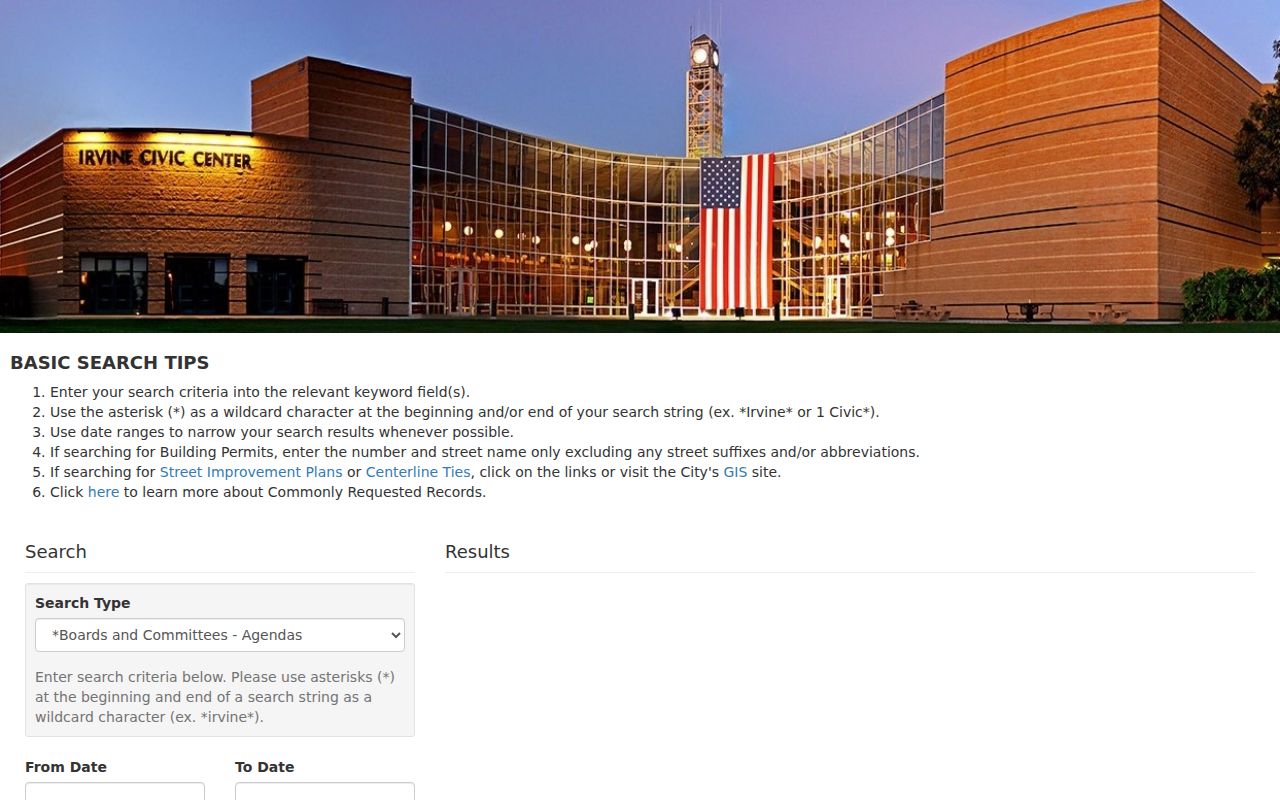
The city's permit index is organized by record series. It does not track every person at a parcel. That is why keyword and date range work together. The detailed Irvine permit inquiry adds owner, applicant, project, address, tract, lot, subdivision, map, and APN fields. The main Irvine Building and Safety portal is the broader entry point for permit and inspection inquiries.

Let the permit trail date a building or alteration event. Then verify ownership or household history through the county and library records that answer that separate question.
Current Irvine Resident Record Sources
The strongest modern sources complement each other. None is interchangeable with another. The public assessment route is parcel-focused, RecorderWorks is party- and instrument-focused, and the voter tool is a self-service confirmation route with authentication. City permits and OnBase records add a municipal timeline, while business and license systems reveal affiliations that can help separate namesakes.
| Source | Best Clue | Keeper | What It Does Not Prove |
|---|---|---|---|
| Irvine GIS and permit records | Address, tract, lot, APN | City of Irvine | Every occupant |
| Assessed-value and parcel records | APN | Orange County Assessor | Current residence |
| RecorderWorks | Party, instrument, legal parcel | Clerk-Recorder | Household membership |
| Your Voter Information | Own authenticated record | Registrar of Voters | Anonymous third-party lookup |
| Directories and newspapers | Name, address, past era | Libraries and archives | Continuous current coverage |
Start with the parcel. The Irvine online parcel search bridges street language to the APN that county systems use. After that bridge, keep parcel work and person searches separate.
Irvine's Recorder Index and the Missing Image
Orange County's RecorderWorks grantor-grantee index is a valuable trail. A deed names the parties to a recorded transfer. The public web index supplies no document image. Save each hit as an index lead: the party role, recording date, document type, instrument identifier, and any book or page reference.
The identifier changed in 1982. For a pre-1982 copy, book, page, and instrument information matter when available. Use the recording year and six-digit instrument number for 1982-forward documents. The Clerk-Recorder is clear on one point. Staff will not run the underlying search by phone, mail, or counter, so the requester must identify the instrument before ordering a copy.
| Grantor / grantee | The grantor transfers an interest; the grantee receives it. Search both roles when rebuilding a chain. |
|---|---|
| Recording date | The date the instrument entered the public record, not necessarily the move-in date. |
| Document number | 1982-forward uses recording year plus six digits; older requests may rely on book and page. |
| Image access | The public index is image-free; copies are ordered separately from the custodian. |
The Orange County RecorderWorks search shows the official index route.
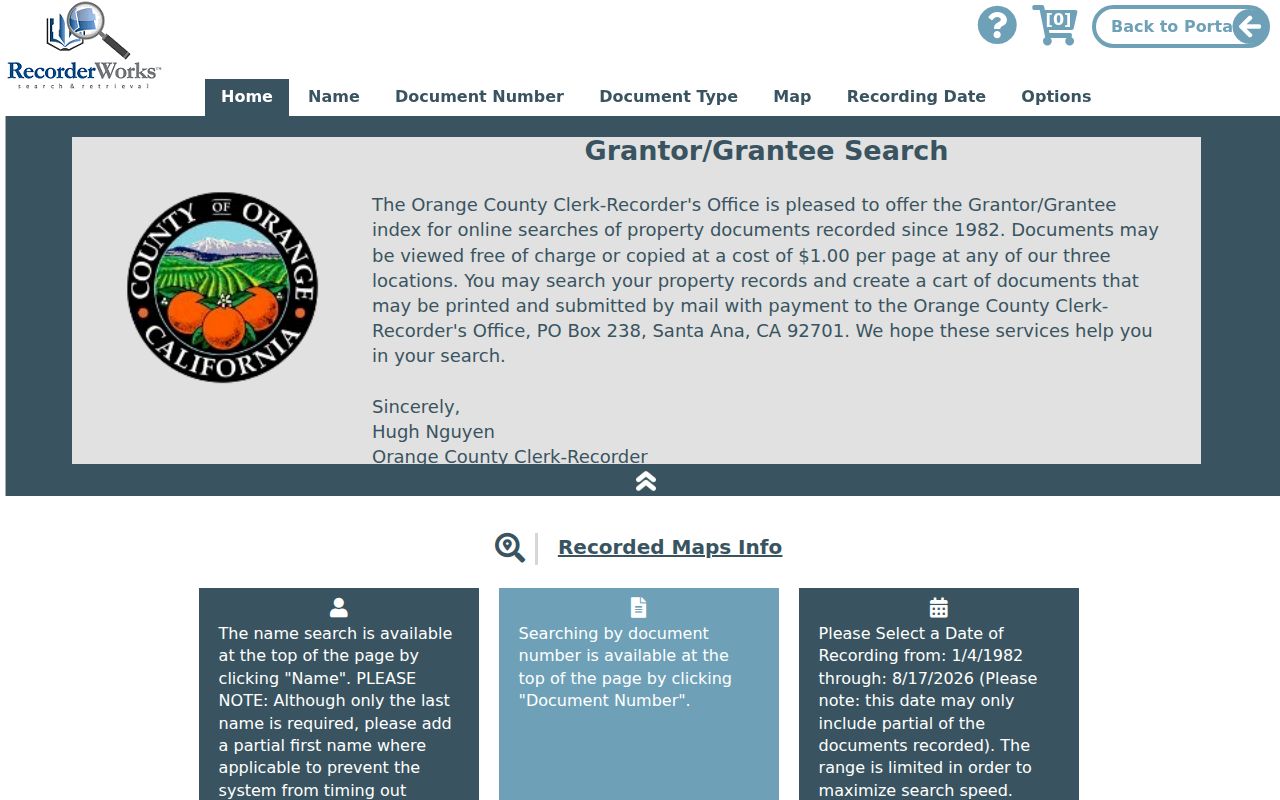
An official copy page explains the separate request path. It lists a $1 per page charge plus $1 certification per document or map. An index hit is a lead, not a deed.
| Route | Strength | Limit |
|---|---|---|
| Custodian index | Named parties and recording facts | Not a household roster |
| Official copy | Document text or image when ordered | Needs an identified instrument |
| Commercial people-finder category | May combine many public and inferred sources | Can be stale, merged, costly, and non-authoritative |
Irvine Assessor Records Start With an APN
Orange County's assessed-value search works differently than a residents directory usually assumes. It is APN-first. Owner-name searching is not allowed by law on the public interface. Find the parcel first. Use the Irvine parcel map or a Treasurer address route. Then carry the APN into the assessed-value tool. The result can show annual land, improvement, and total values, plus exemptions and parcel context. The owner's mailing address does not appear online.
There is a counter fallback. The Assessor lists property information access at 500 S. Main Street, 2nd Floor, Orange, open Monday through Friday, 8 a.m. to 5 p.m. Call 714-834-2727 for the office. Published products include map copies and roll screens, with charges and schedules worth confirming ahead of a visit. An assessed owner does not always occupy the parcel, so treat a parcel value as value, not residency.
The Orange County Assessor property information page walks through the ParcelQuest route.
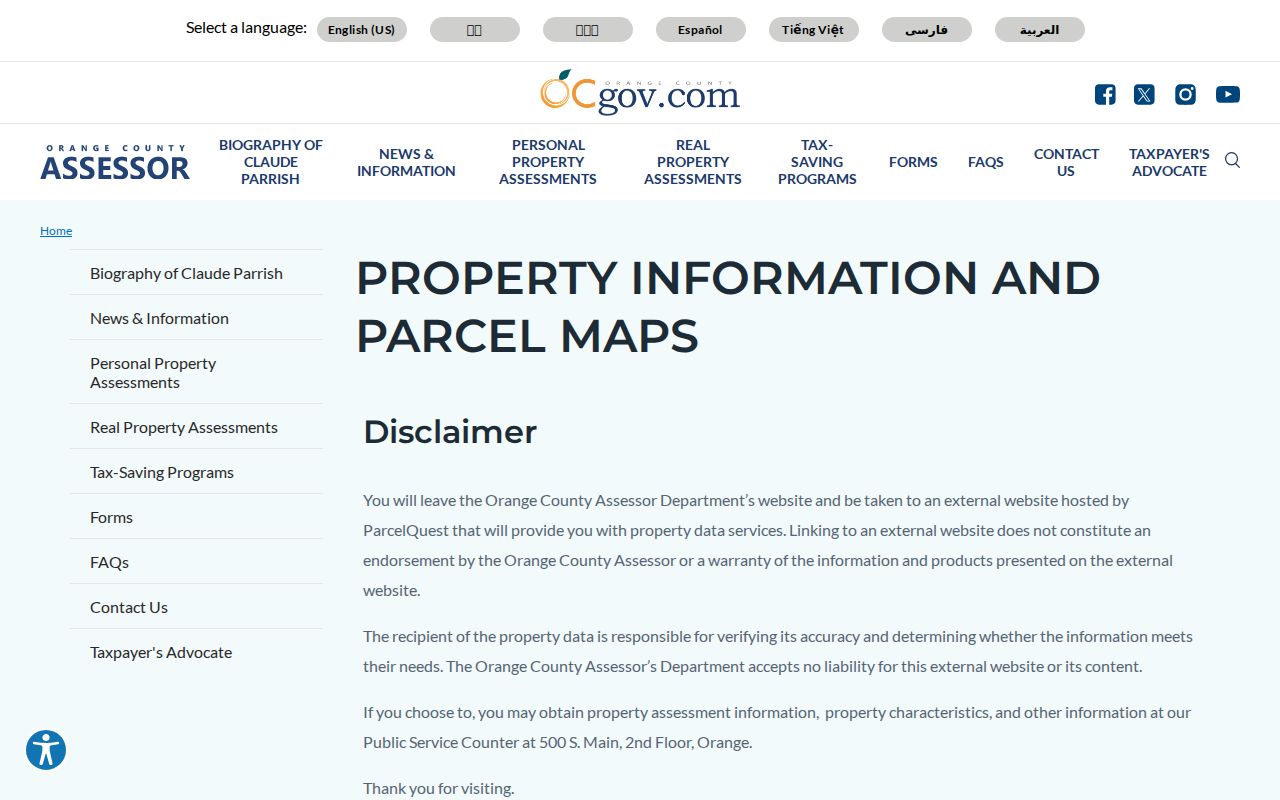
Read the fields as one set: map, APN, situs, assessment. Mailing and situs addresses can differ, and the county's public web result never turns that gap into a name directory.
- APN
- An assessor parcel number, used as the stable key for a mapped tax parcel.
- Situs address
- The physical location of the parcel, which can differ from a tax-mail address.
- Roll
- An assessment record for tax purposes, not a list of every person at the address.
- Index
- A finding aid that points to a record; it may not include the record image.
Orange County Voter Lookup Has a Lock
California voter registration data is not ordinary browse data. Orange County's Your Voter Information tool verifies the person asking, not just the record. You must supply a full date of birth. Acceptable second factors are the last four digits of a California license or ID, or of an SSN when no California ID exists. Your first name's first three letters are required too. Once authenticated, the tool can return registration status, mailing address, party, history, districts, ballot status, and address confirmation for that user.
| Date of birth | Full month, day, and year. |
|---|---|
| ID or SSN last four | Last four of a California driver license or ID, with the stated SSN fallback. |
| First name | First three letters, used as part of authentication. |
| Result functions | Status, districts, voter history, ballot details, and address confirmation for the authenticated record. |
The Orange County voter self-lookup is not a casual Irvine street search.
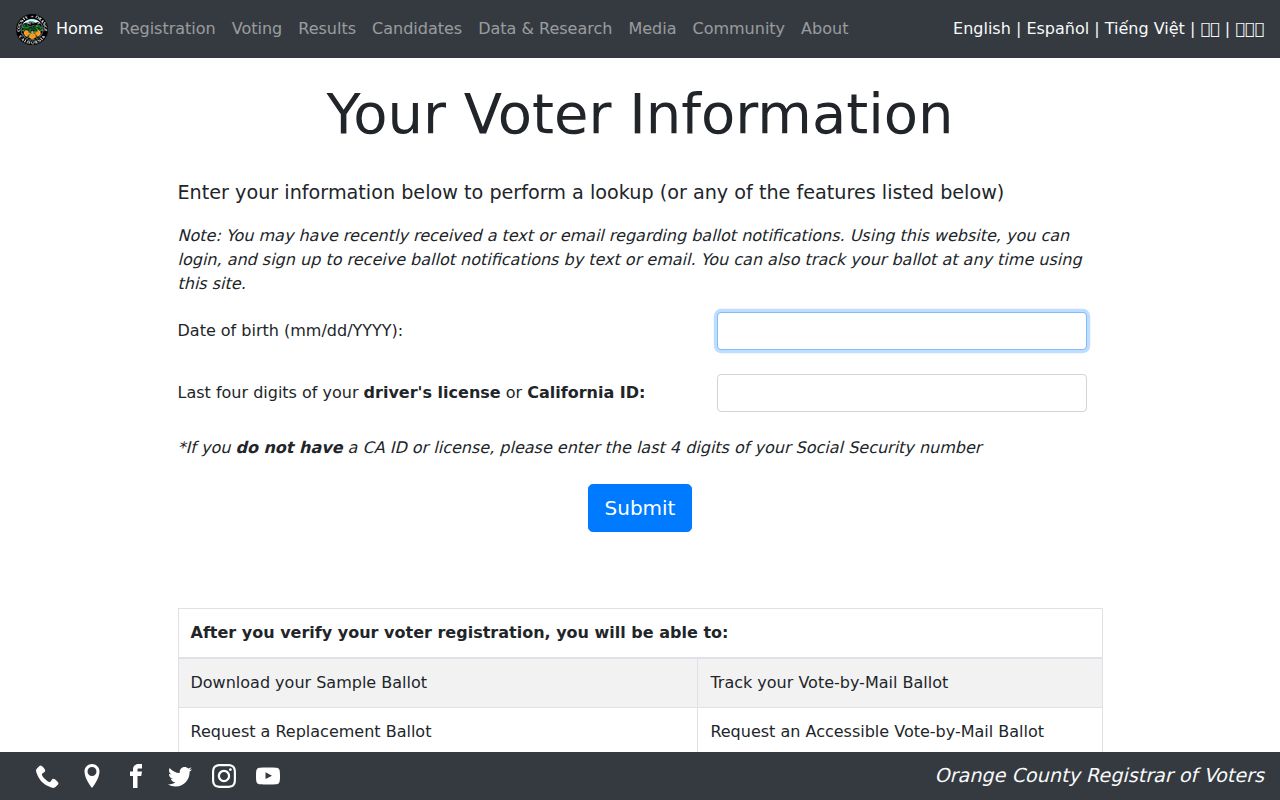
Qualified requesters take a different path. The Registrar requires a separate application, an original wet signature, supporting documents, a stated permitted use, storage controls, and payment. Elections Code sections 2188, 2194, and 18109, plus 2 CCR sections 19001 through 19013, restrict access and use. An Irvine residents directory should never republish a voter file. Nor should it imply anonymous browsing is possible. The Registrar's office information page gives the public contact and records-request route for voter system questions.
Privacy boundary. A public Irvine records search is for lawful personal research and civic understanding. Do not republish protected voter information or use a resident clue to stalk, harass, intimidate, or threaten anyone.
Cross-Check an Irvine Name Before Matching
A name only becomes useful when several independent facts line up. Keep a worksheet. Track the middle initial, suffix, former name, spelling variants, chronology, and known locality. A court party name, assessor parcel, business filing, or license result is only a candidate. Never match on one alone. Irvine's size and language mix make transliteration and same-name caution practical rather than theoretical.
Orange Superior Court's online services cover calendar, case access, index, and name-search modes. Results may show a case number, filing date, case type, and party roles. They may also include register-of-actions entries, hearing dates, department, disposition, and public document links. Some family, juvenile, sealed, and adoption material can be restricted. The court's current designation list matters. Irvine cases may sit among several Orange County justice centers.
Begin at the Orange Superior Court online-services gateway.
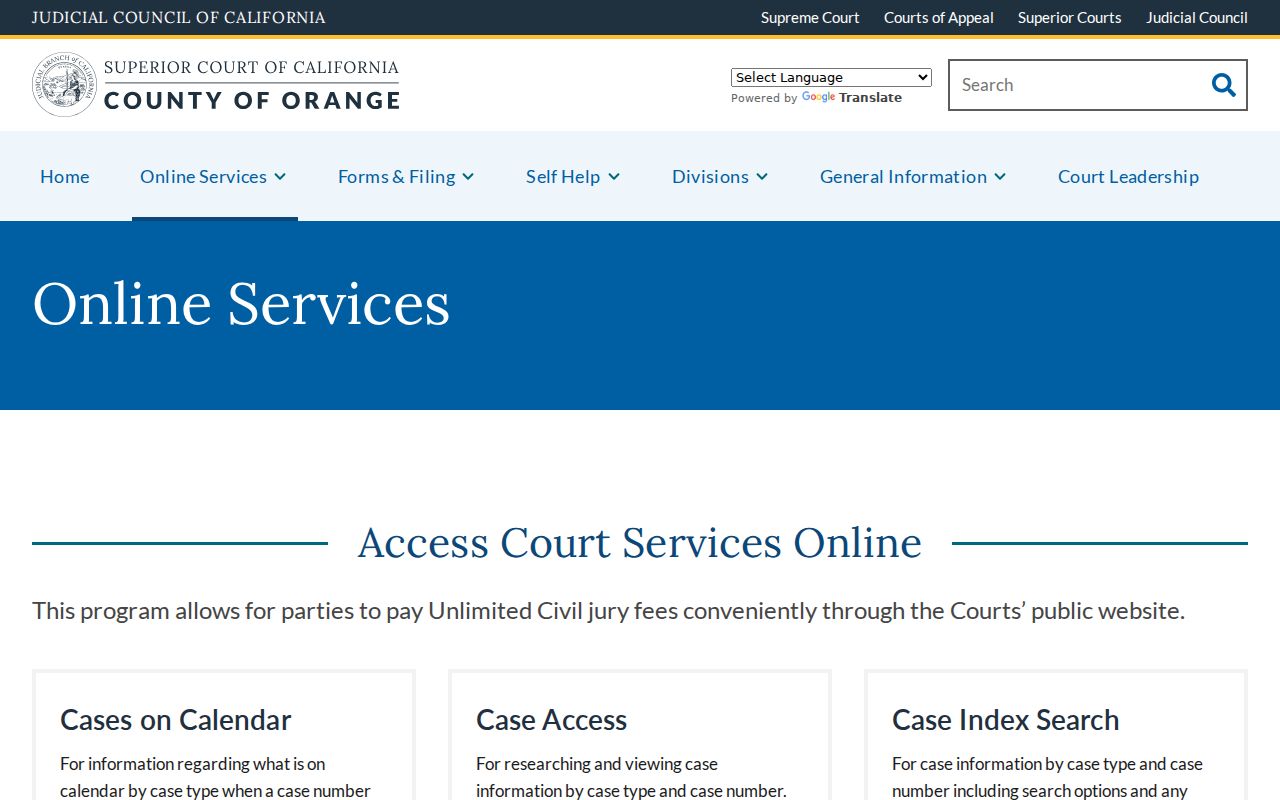
For a name-to-address lead, the careful flow runs from known name and variants, to parcel or deed evidence. Then it moves to business or license affiliation, to court chronology, and then a separate vital or genealogy check. That sequence keeps weak evidence from hardening into a claim. Sometimes the address is the real question. Then switch to the address-focused page. Do not turn a court result into a residence claim.
California Vital Records Use Copy Rules
Birth, death, and marriage records follow different custodians. Access rules differ too. The Clerk-Recorder handles county events and certificates. The California Department of Public Health handles statewide record routes by type and year. California splits authorized certified copies from informational certified copies rather than opening every record after one simple age cutoff. Public marriage, confidential marriage, and divorce records each sit under their own rules.
| Record | Custodian | Research Use | Boundary |
|---|---|---|---|
| Birth | Orange County or CDPH | Relationship and event lead | Authorized-copy eligibility; informational copies are marked |
| Death | Orange County or CDPH | Family and obituary chronology | Copy type and requester rules apply |
| Public marriage | Orange County or CDPH | Spouse and date confirmation | Eligibility varies by copy |
| Divorce | Orange Superior Court | Case or decree route | State certificate is not the decree |
Health and Safety Code sections 103525 and 103526 govern authorized and informational copy treatment. Family Code section 509 restricts confidential marriages. Adoption originals are sealed under Health and Safety Code section 102730 and related law. County ordering runs in person or by mail. Notarization or a sworn statement applies when required. Genealogy indexes can help you find an event. But they never replace the lawful copy process.
The Orange County Clerk-Recorder service list separates real-property, vital, marriage, fictitious-business-name, and registration records.
Historical Irvine Resident Directories Start Earlier
Irvine's directory history starts before the city itself. Look under Orange County, Irvine Ranch, Santa Ana, or another older locality for the earliest resident listings. The city did not incorporate until 1971. Before that, the ranch and university village pattern had already shaped who lived where. The best verified early lead is Milliken's Orange County Directory for 1895-1896, a 205-page county directory that named resident acreage owners and set Irvine-area people in a countywide frame.
Other shelves add depth. The 1903 Orange County Directory is one. Santa Ana and Orange County volumes are cited for 1905-1931, and county descriptions overlap from 1928 through 1952. There is also the circa-1930 NARA grouping, Orange County Archives holdings, OCPL genealogy databases, newspapers, and UCI's Orange County Regional History Collection. No authoritative source shows a continuous Irvine-titled publisher run or a complete open reverse-directory series. The Irvine city directory collections page keeps those dates, gaps, and research desks distinct from the current-record workflow.
Irvine Business and License Records Add Context
Two people with the same name are easy to confuse. A business or professional filing can supply a middle name, a date, a license number, or an affiliation. California Secretary of State bizfile Online shows entity name and number, formation or registration date, status, jurisdiction, agent, addresses, officers, managers, filing history, and imaged statements. One caution applies. The address belongs to the entity or its agent, not automatically to anyone's home.
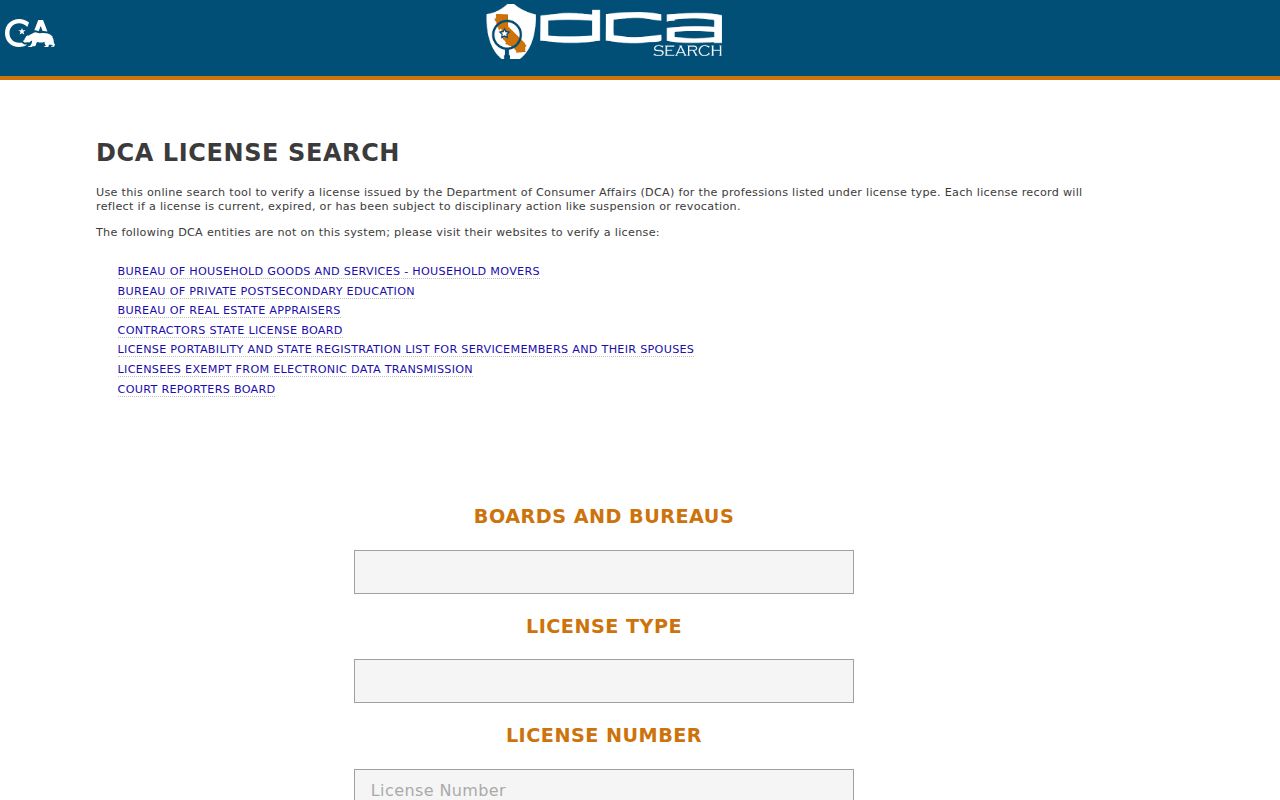
Department of Consumer Affairs results vary by board. They can show a licensee or business name, license type and number, status, issue and expiration dates, address of record, and public discipline. A fictitious business-name record ties a local DBA to its registrant, and State Controller unclaimed-property results may add an older reported address. Claimants must prove entitlement. That address is historical rather than current.
For entity affiliation, start with the California business search.
For an occupation or credential lead, the California license search is the companion route.
Treat these records as sorting tools, nothing more. Use them to separate people and timelines in an Irvine residents directory search, never to assume a work or agent address marks a residence.
Irvine's Library Context Changed in 2025
Library access in Irvine shifted recently. Irvine Council approved leaving Orange County Public Libraries in 2024. Irvine Public Library launched its own system on July 1, 2025. Heritage Park and University Park transitioned. Katie Wheeler followed a separate lease and closure schedule. So an older directory's catalog card, branch rule, or database login may no longer be the active route.
OCPL research pages still document valuable tools. These include Ancestry Library Edition, NewsBank coverage of the Orange County Register from 1987-current and Irvine World News from 2003-current, HeritageQuest, Fold3, and obituary assistance. Branch-only access and card privileges still matter. Confirm the current holder before counting on any shelf or database. Ask staff about OCR variants, microfilm, and named years. A gap rarely means a record never existed.
The city's background page on the Irvine Public Library transition explains why old access notes need rechecking.
When Irvine Records Stop, Use CPRA
The California Public Records Act is the official fallback. It covers an identifiable existing city or county record that is not online. Government Code sections 7920.000 and following let any person request a describable record. A purpose is usually unnecessary. The agency generally has 10 days. That clock covers the determination only. Unusual circumstances allow a written extension of up to 14 additional days. Copies can take longer.
Irvine Form 10-06 asks for a description, date or record context, and contact information. A request can seek inspection or copies. CPRA does not require the city to create a new resident list, reveal protected voter or vital information, or override an exemption. Describe what you know. An address, tract, lot, APN, project, document type, and date range all help the records office respond. If the custodian is the county, send the request to the county office rather than the City Clerk.
For a precise address or APN, the Irvine parcel viewer is a good starting point.
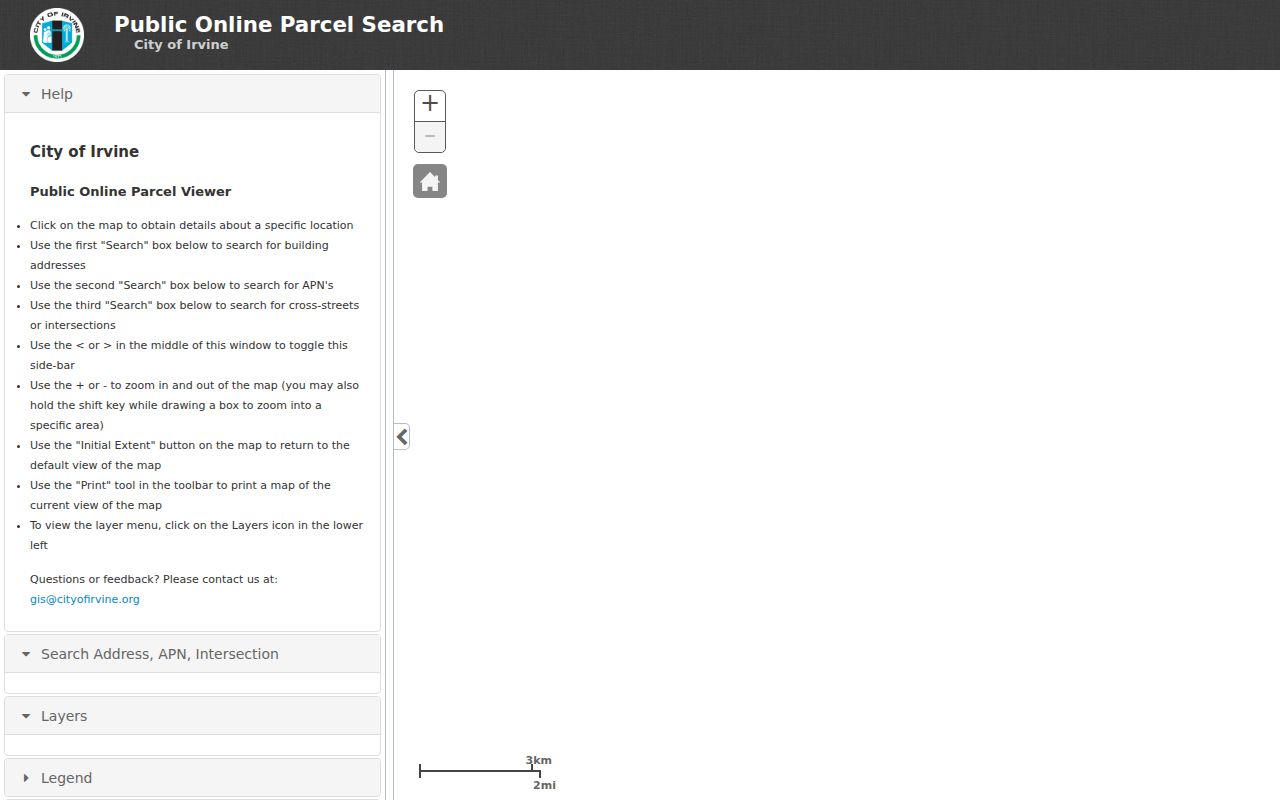
Pin down the parcel or record series first. Then the Irvine Form 10-06 public-record request, or the relevant county route, gives the records office something it can locate. A focused request keeps the Irvine residents directory trail tied to a real custodian. Vague asks slow everything down.